


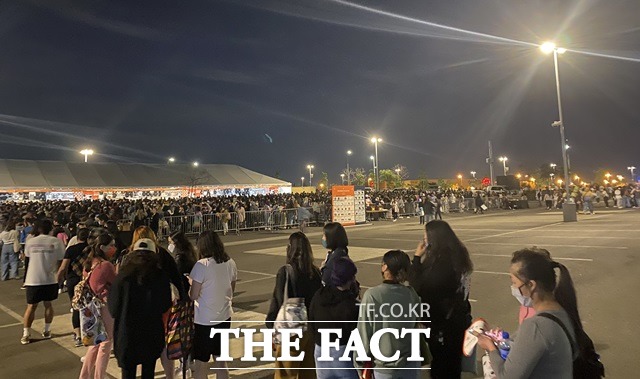
On the 21st, BTS is scheduled to hold a comeback performance at Gwanghwamun Square in Seoul. It is expected that up to 260,000 people will gather for this event. Accordingly, the three mobile carriers have prepared communication quality management measures, and the police and Seoul city have decided to strengthen control over surrounding buildings.
The three mobile carriers will take various technical measures to respond to the surge in communication traffic on the day of the performance. SK Telecom will operate the AI-based network operation system 'A-One' to monitor on-site communication traffic in real time. This system can quickly respond to increases in the number of connected users, changes in communication quality, and equipment abnormalities. In addition to the existing communication network, temporary facilities are being additionally constructed, and separate facilities are being installed in areas with heavy roaming usage.
KT will operate an emergency work system centered at the Gwacheon Network Control Center and apply the AI-based traffic management solution 'W-SDN.' Six mobile base stations, 79 wireless base stations, and 14 Wi-Fi units will be additionally deployed around Gwanghwamun Square and City Hall Square to expand network capacity. LG Uplus will use autonomous network technology to predict traffic fluctuations before the event and manage communication quality through an operation system linking the site and the control room.
The police and Seoul city will strengthen control over 31 surrounding buildings on the day of the performance. They have discussed safety management plans with security personnel of each building and requested that the front entrances of the buildings be closed and only the rear entrances be opened on the day of the event. This measure is to prevent spectators from bypassing official entrances through the interior of buildings to enter the venue.
Seoul city has requested access control to rooftops and upper floors of 24 buildings, excluding the U.S. Embassy in Korea and six public buildings. This is to prevent safety accidents that may occur when fans who could not obtain tickets enter rooftops or balconies. Completely closing rooftops without automatic open/close devices may violate the obligation to secure emergency evacuation routes under fire safety laws, so Seoul city is inspecting the installation of rooftop automatic open/close devices and coordinating customized management plans for each building.
About 6,500 police officers will be deployed on the day of the event. Various police forces, including about 70 riot squads, traffic, criminal investigation, crime prevention, and special forces, will be stationed on site. To prepare for the possibility of terrorism, metal detectors will be installed at 31 official entrances from 7 a.m. on the day of the performance, and special police forces and riot squads will be deployed inside the gates. To prevent vehicle-ramming attacks, tire spikes, barricades, and police buses will be placed around the venue.
Traffic control will also be implemented early. Vehicle traffic will be restricted on Sejong-daero from Gwanghwamun to City Hall from 9 p.m. on the 20th, the day before the performance, until 6 a.m. on the 22nd, the day after the performance. The police plan to control entrances and block additional inflow when the crowd density on site rises to more than two people per square meter.
Due to the expected large crowd at this BTS performance, thorough preparations are underway to maintain communication quality and prevent safety accidents. The police and Seoul city are preparing various measures with the safety of spectators as the top priority.

 Previous Article


